Who in your organisation needs to learn AI, and who does not
A day of AI training for everyone gives too much to people who do not need it and too little to the few people it depends on. A practical split into five groups, with the legal floor explained correctly.

Not everyone in your organisation needs to learn AI, and almost nobody needs to learn it to the same level. In a company of 50 to 350 people, a small group makes the difference: the management team that decides and judges, the process owners who see where AI can take over work, and for each application two or three people who actually build it and work with it. The rest of the organisation needs a foundation that fits what they do with AI. That foundation is also what the AI Act asks for. It is a floor. If you give everyone the same course, you pay for a lot of hours that deliver little, and you give the few people who needed more too little.
This piece is written for the director or owner who has to divide a training budget for AI, or who has a quote on the table for "AI training for all employees" and has doubts. It sets out five groups, with for each group what they need to be able to do, how deep, how they learn it and how much time it takes.
We have worked out a few related subjects separately, and we will not repeat them here. What the legal obligation involves and how to make it demonstrable is in AI literacy of staff. Why the role you are looking for often already exists in your company is in Building AI capability without your own AI team. How to stop the knowledge leaving with one person is in How to anchor AI knowledge. This piece is about the question in between: who learns what.
Why training everyone wastes money
Training for the whole company feels fair and careful. Everyone gets the same, nobody is left out. Just do the sum.
Take a company of 150 people that gives everyone a day of training. That is 1,200 hours. Statistics Netherlands (CBS) put the average labour cost per hour worked in 2024 at 45 euros. That one day then costs 54,000 euros in hours alone, before the trainer's invoice. That is money you can only spend once.
What do you get back? A day of general explanation about what a language model is and which tools exist. For the warehouse worker who does not use any AI tool, it is a day away from work. For the colleague in the sales office who will start working with a new system next month, it is too general, because it is not about her system and her orders. And anyone who learns something and then does not use it for weeks loses most of it again. Everyone who has ever taken a course knows that.
The biggest problem sits on the other side. The two or three people who will soon have to build and adjust an application get the same day as everyone else. For them, one day is far too little. They need weeks, on real work, with someone looking over their shoulder. An even split therefore gives too much to people who do not need it and too little to the people it depends on.
There is one more reason not to split evenly: AI does not land evenly in a company. CBS reports that companies using AI deploy it most often for marketing or sales (35 percent) and for business administration or management tasks (32 percent), and least for logistics (4 percent). Use is growing fast: among companies with 50 to 250 employees, the share using AI rose from 20 percent in 2023 to 45 percent in 2025, and among companies with 250 or more people it stands at 66 percent. But within a company, that use sits in a few departments and a few processes. That is where the learning belongs as well.
What the law asks, and what it does not
Article 4 of the AI Act, Regulation (EU) 2024/1689, has applied since 2 February 2025. It was amended in July 2026 by the Digital Omnibus, Regulation (EU) 2026/1744. The text that now applies says that providers and deployers of AI systems take measures to support the development of AI literacy of their staff and other persons dealing with the operation and use of AI systems on their behalf. In doing so, they take into account their technical knowledge, experience, education and training and the context the AI systems are to be used in. The new text explicitly adds that the obligation does not require providers or deployers to guarantee any specific level of AI literacy of any individual.
Three things stand out when you read that with the question of this piece in mind.
The law itself asks for distinction. Taking knowledge, experience and context into account means the warehouse manager and the controller do not need to get the same thing. The European Commission says so literally in its questions and answers on AI literacy: different levels of training and different learning approaches can be appropriate.
The law is about people who work with AI systems. The text names staff and others who operate and use AI systems on your behalf. Temporary workers and contractors are therefore included. People who do not work with AI systems at all are not the group the text is aimed at. In practice that line moves quickly, because AI features keep appearing in ordinary software. That is why the last group below also gets something, even if it is little.
The law does not ask for a certificate. The Commission writes that a certificate is not needed and that an internal record of trainings and other initiatives is enough. A vendor selling you a certification programme for everyone on the basis of Article 4 is selling more than the law asks for.
That makes the legal obligation a floor you can reach with little effort. Your company's goal is higher: that AI actually takes over work somewhere and that your own people can run it themselves afterwards. A basic level for everyone does not get you there. For that you need a few people who can do much more. This is not legal advice; if you want to know how the obligation works out in your situation, read the piece on the obligation and the sources at the bottom.
Five groups, five different questions
Below is the split we use for a company of 50 to 350 people. The times in the last column are our own rule of thumb for calculating, not a measured standard. They depend on how many applications you take on at once and how complex they are.
| Group | What they need to be able to do | How deep | How they learn it | How much time (rule of thumb) |
|---|---|---|---|---|
| Management team (2 to 6 people) | Choose which application comes first, judge a proposal, assign ownership and risk | Judgement and decision-making, no technology | Sitting in on a real application and taking the decisions in it themselves | A few hours per quarter |
| Process owners and team leads | See which work is suitable, own an application, judge outcomes and set limits | Enough to tell a good outcome from a wrong one | On their own process, together with the doers | Half a day to start, then one to two hours a week while their application runs |
| Doers, 2 to 3 per application | Build, configure, test, adjust and explain to colleagues how it works | Deep, on that one application | By building it themselves with guidance, on real data and real work | A few hours a week during the build, then a fixed slot for maintenance |
| People who use AI tools | Know what may and may not go into a tool, recognise a wrong outcome, know whom to report to | Basic, focused on their own tools | Short sessions on real cases from their own work | One to two hours to start, then half an hour per quarter |
| People who do not use AI systems | Know that agreements exist and whom to turn to | Awareness | In the team meeting or during onboarding of new people | Fifteen minutes to half an hour |
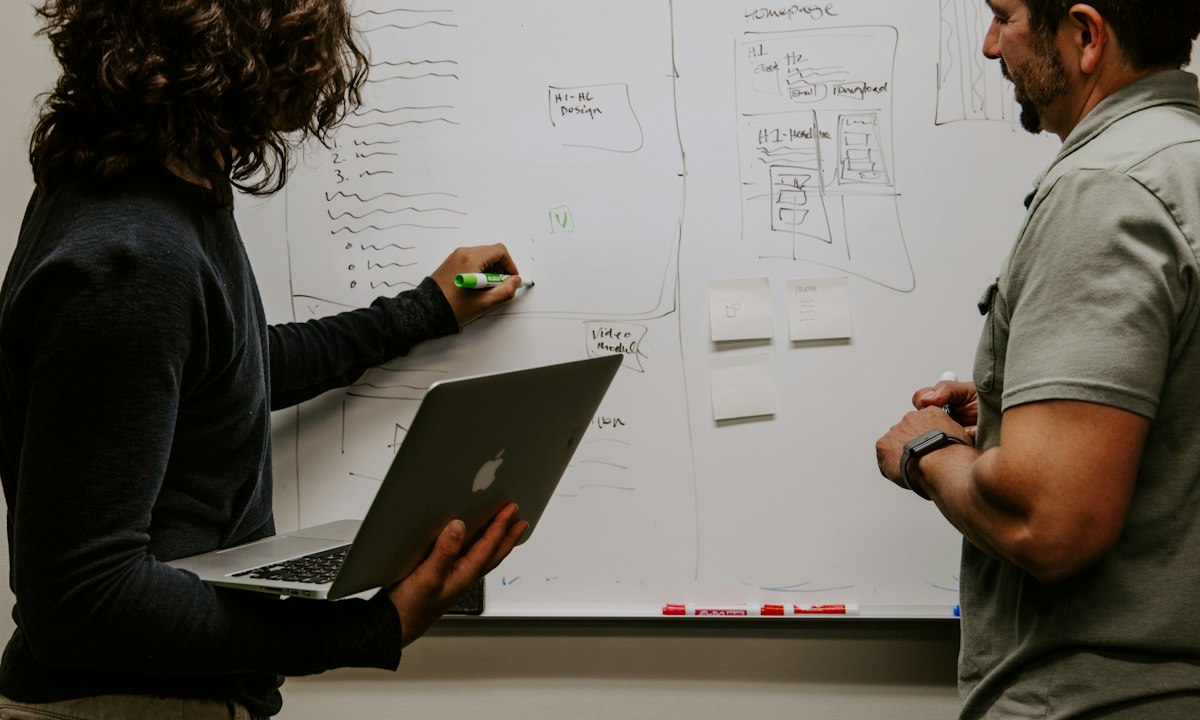 Two colleagues mapping a process on a whiteboard. The person who knows the work sees first where AI fits.
The management team: deciding and judging
The management team does not need to know how a model works. It needs to be good at three things. Choosing which application comes first and which deliberately does not. Judging a proposal on cost, risk and reversibility. And naming an owner for each application who is also given the time for it.
You do not learn that in a presentation about what AI can do. You learn it by sitting at the table during the first application at the moments when something is decided: which process, which data may go in, when do we stop, who becomes the owner. After one or two applications, a management team recognises the questions that matter. A few hours per quarter is enough, provided those hours fall on real decisions.
The person who buys software often belongs here too. In many companies of this size that person sits in the management team or in finance, not in IT. They need to know which questions to ask a vendor about data and about what remains when the contract ends.
Process owners and team leads: seeing and owning
This is the most underestimated group. A sales office team lead, the head of planning, the controller. They know which work repeats itself, where the errors are and what a good outcome looks like. That last point is exactly what you need to judge whether an AI application works.
They need to be able to see which work is suitable for AI and which is not, to own an application once it exists, and to set limits: the system may prepare this, a person always decides that. They do not need to build. They do need to understand enough to steer a doer and to recognise a wrong outcome before it reaches a customer.
Process owners learn best on their own process. Half a day to name the first opportunities in their own work, and after that one to two hours a week taking part while their application is being built. A process owner who does not have an application yet does not need to learn more than the basics. The learning follows the application.
They are also the ones who have the conversation with their team. People wonder what AI means for their job, and that question reaches the team lead first. How to have that conversation without feeding the fear is in Getting more from the people you already have. The aim is to take work off someone's plate, not to replace anyone.
The doers: two or three per application
For each application you need two or three people who can really do it: configure, test, adjust instructions, work out why an outcome is wrong, and explain it to a colleague. That is the deepest layer, and it is a small group.
These people usually already work for you. It is the planner who built a spreadsheet nobody else understands, or the colleague who already works with a tool on their own initiative. They need time, a mandate and someone who can explain the next step when they get stuck. Hiring a new AI specialist is not yet the first step for most companies of this size; why not is explained in Your first AI hire.
Why two or three and not one? Because knowledge that only one person has leaves when that person leaves, falls ill or goes on holiday. A second person who actually operates the application is the cheapest insurance there is.
Doers learn by building. A course helps little if you do not yet have an application to try it on. What works: a real application, on real data, with guidance from someone who has done it before, where the doer operates the controls and the guide looks on. Count on a few hours a week during the build. After that a fixed slot remains necessary for adjustments, because processes and tools change.
 Three colleagues working on one laptop. Doers learn by building, with a second person who also knows how it works.
People who use AI tools: the basics done well
This is the group Article 4 is mostly about. Employees who use an AI feature in their software, use a chatbot for draft texts or work with a system that prepares something. They need to know three things: what may and may not go into a tool, how to recognise an outcome that is wrong, and whom to report to when something goes wrong.
That is not a day's work. One to two hours to start, focused on the tools they actually use, and after that half an hour per quarter on a real case from their own work. What such a half hour looks like and how to record it is in the piece on the obligation. The agreements themselves belong in your AI policy.
People who do not use AI systems: little, but not nothing
Some of your people do not work with AI systems. Think of production, the warehouse, field service or cleaning, depending on your company. They do not need training. It is sensible, though, that they know there are agreements about AI and whom to turn to if they want to try something themselves. Fifteen minutes in the team meeting is enough. As soon as someone from this group starts working with an AI feature, that person moves up a group.
What the learning looks like: in the work, on a real application
The split above only works if the learning is tied to the work. Three rules help.
Let the learning follow the application. Do not plan a training week in January. Plan the learning around the applications you are going to build. A doer starts learning when their application starts. The sales office gets the basic session in the week the new system reaches them. That way everyone uses what they learn within days, and it sticks.
Practise on real work. An exercise with an invented case teaches you how a tool works. A session on your own orders, your own quotes or your own planning teaches you where it goes wrong in your company. That second kind of knowledge is what matters, and you only get it on real work.
Everyone explains it once. A doer who explains their application to the process owner, or a process owner who explains it to their team, discovers what they do not yet understand themselves. It is also the way knowledge spreads without setting up a programme for it.
A classroom is not forbidden. A short explanation beforehand can help, especially for the group that will use AI tools. But most of the learning happens at the desk, on the day it is needed.
Worked example: a company of 150 people
A hypothetical example, with invented but realistic numbers, to show how the split works out. It covers the first year, with two applications.
Suppose: a company of 150 people. Four people in the management team. Ten process owners and team leads, two of whom get an application. Three doers per application, so six in total. Seventy people who use AI tools. The remaining sixty do not work with AI systems.
| Group | Number | Hours per person in year 1 | Total hours |
|---|---|---|---|
| Management team | 4 | 12 | 48 |
| Process owners and team leads | 10 | 22 for the two with an application (half a day to start, 1.5 hours a week, 12 weeks), 8 for the other eight | 108 |
| Doers | 6 | 48 (4 hours a week, 12 weeks) | 288 |
| People who use AI tools | 70 | 3.5 (an hour and a half to start, four times half an hour) | 245 |
| People who do not use AI systems | 60 | 0.5 | 30 |
| Total | 150 | 719 |
At 45 euros an hour, that is about 32,400 euros in hours, against 54,000 euros for one day of training for everyone. The totals differ less than you might expect. The real difference is where the hours land. In this example, more than sixty percent of the hours go to twenty people: the management team, the process owners and the doers. With one day for everyone, those same twenty people get 160 hours together, and the doers eight hours each, while in this example they get 48 each.
To be clear: this is a worked example, not a figure from experience. Your numbers, your applications and your rate will give a different outcome. The ratio is what counts: a lot for few people, a little for many people.
Where it goes wrong
Everyone gets the same e-learning and then nothing happens. You meet the floor and build no capability. A year later nobody remembers what was in it.
Only IT is sent. IT knows the systems, the process owner knows the work. If only IT learns, the knowledge lands where the process is not, and nobody can judge whether the outcome is right.
The management team skips itself. A management team that lets the team learn but does not sit at the table for the first decisions cannot judge the next proposal. It then gets chosen on enthusiasm instead of evidence.
There is one doer, but no second. Everything then depends on one person. How to prevent that is in How to anchor AI knowledge.
Training happens before there is an application. People learn something they will only need months later, and by then they have lost it. Start with the application and let the learning run alongside it.
 Four people leaning over a document on a table. A management team learns by taking the real decisions itself.
Where the Capability Sprint fits
The deepest layer of this split, the doers and their process owner, learns the most while building a real application. That is what the Capability Sprint is for. It is the build phase in which Radical delivers the first working AI application together with your own people, with handover as the goal: your team can run and adjust it themselves afterwards, without the external party.
Who takes part? According to the description: the people who know the process and will keep working with it afterwards, plus whoever owns the decision. Sending only IT defeats the purpose, because the knowledge then lands where the process is not. In the split of this piece, those are the doers, the process owner and the management team.
What is delivered: a working application in production, your own people involved in the build rather than watching, and the way of working recorded so that it survives someone leaving. The test of success does not come at delivery. It is the first change your own team makes to the system without calling anyone.
The sprint is the third step. The free AI-Foto shows where you stand, the AI Readiness Scan establishes which opportunity delivers the most and is feasible, and the sprint builds the first item on that roadmap. That also tells you straight away who in your company are the doers and the process owner for that first application.
About this page
This piece was written on 5 October 2026 by the Radical AI team. The text of Article 4 was checked against the Dutch versions of Regulation (EU) 2024/1689 and of the Digital Omnibus, Regulation (EU) 2026/1744, on EUR-Lex. The statements about different levels and about there being no certificate requirement come from the European Commission's questions and answers on AI literacy. The figures on AI use by company size and by purpose, and the 45 euros labour cost per hour worked, come from CBS. The split into five groups and the times in the table are our own rule of thumb, not a measured standard. The example of the company with 150 people is hypothetical. The description of the Capability Sprint comes from our own page. No client data was used. This is not legal advice.
Frequently asked questions
Sources
- EUR-Lex: Verordening (EU) 2024/1689 (AI Act), artikel 4 AI-geletterdheid en artikel 113 over de toepassingsdata— eur-lex.europa.eu ↗
- EUR-Lex: Verordening (EU) 2026/1744 (Digital Omnibus on AI), met de nieuwe tekst van artikel 4— eur-lex.europa.eu ↗
- Europese Commissie: AI Literacy, Questions and Answers (verschillende niveaus, geen certificaat nodig)— digital-strategy.ec.europa.eu ↗
- CBS: Bedrijven gebruiken AI vaakst voor marketing of verkoop (AI-gebruik naar bedrijfsgrootte en doel, 2025)— cbs.nl ↗
- CBS: Loonkosten per gewerkt uur 6 procent hoger in 2024 (45,0 euro per uur)— cbs.nl ↗
- Radical: Wat is een Capability Sprint, met wie er meedoet en wat er wordt opgeleverd— radicalai.nl ↗
Tell us what you need.
We respond within 24 hours, from a real human.
Get in touch