AI in construction: where the money is
Every project is unique, unlike a repeatable delivery route. Where AI pays off in construction: estimating, coordination and site documentation.

Dutch construction counts nearly 270,000 companies, and of that group 950 have fifty or more employees. In the second quarter of 2026 there were 28,600 open vacancies in the sector. Of companies with 50 to 250 people, 41 per cent already use AI, against 73 per cent at the largest companies. That is higher than in most sectors we covered earlier, and at the same time less visible in AI content, which mostly targets office work.
This piece is about where the money is in construction: not on the building site itself, but in the estimating, planning and administration around it.
Why construction differs from the other sectors we covered
We wrote earlier about logistics and wholesale. Both run on repeatable processes: the same trip, the same item, over and over. Construction runs on the opposite. Every project is unique, every client wants something different, and site conditions are never quite the same as the last project.
That does not mean AI pays off less here. It means the applications differ. Where logistics and wholesale forecast based on repetition, construction is about making work that is already done by hand faster and more accurate: estimating, planning, and checking whether the work meets requirements.
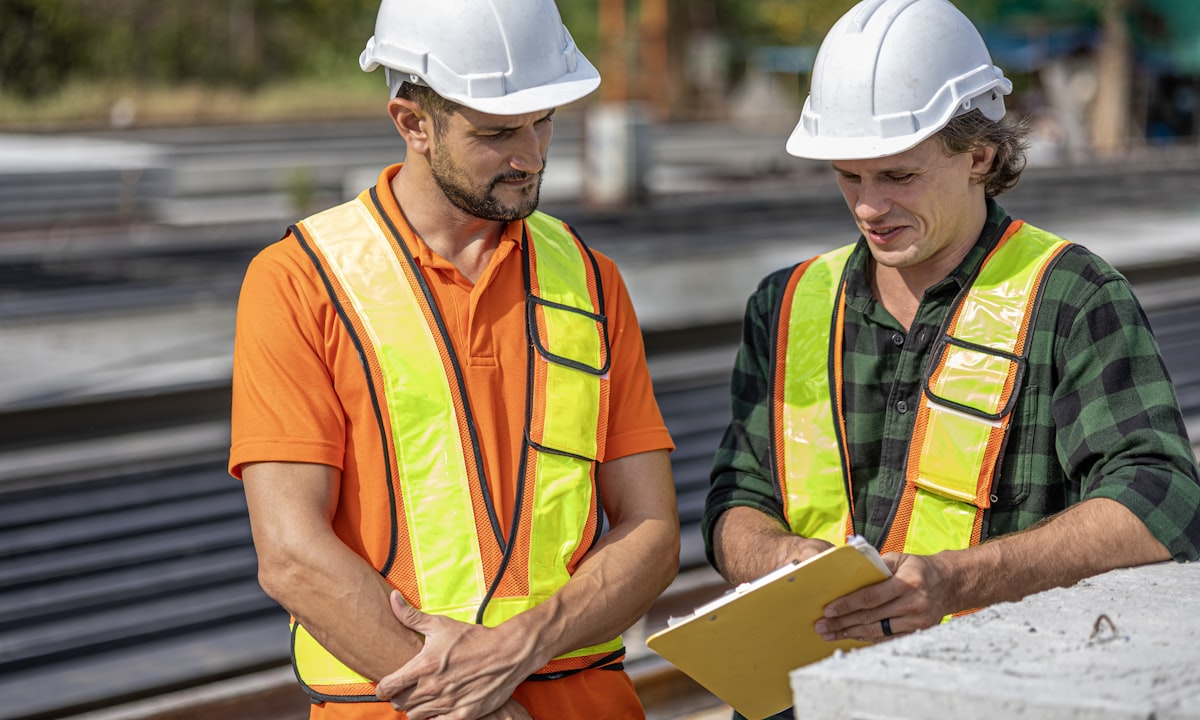 Reviewing plans on site. Every project is unique, unlike a repeatable logistics route.
The three places the money is
Estimating. A quote for a construction project takes hours to put together, and its accuracy depends on how much experience the estimator has with comparable projects. A system putting old estimates and actual final costs side by side learns where an estimate is structurally too optimistic, improving the single most important forecast in the whole company: will this project make money.
Planning and coordination. A construction project has dozens of subcontractors who have to work in sequence, and a delay with one pushes everything back. A planning system that flags bottlenecks early does not save construction time itself, but it does save the costly downtime that comes from the wrong party arriving at the wrong moment.
Quality control and documentation. Image recognition spotting progress or defects in site photos does not replace the inspector but speeds up the process of recording what has been done and what still needs doing, something construction traditionally does by hand and with delay.
 Checking a tablet on site. Old estimates against actual costs reveal where a company miscalculates.
What you already have
A construction company this size builds up, after a few years, an archive of completed projects: the original estimate, the actual final cost, delivery date versus planned date. That archive is rarely used systematically to improve the next estimate, even though it is exactly the data needed for that.
The same holds for site photos, which currently mostly serve as evidence in disputes and are rarely used to recognise progress or flag defects early.
Why the AI Act weighs heavier here than in the other sector pieces
Unlike logistics and wholesale, where we could say the AI Act barely applies, that is more nuanced in construction. Systems monitoring site safety, such as cameras recognising dangerous situations, can fall under stricter rules depending on the exact application, particularly if they process personal data on individual workers. Check any application recording something about a specific employee separately against Article 5 and your own AI policy.
The sum for a mid-sized contractor
Take a contractor completing twenty projects a year with an average revenue of four hundred thousand euro each, so eight million euro total. A structural over-estimate of just two per cent, projects that looked profitable on paper and were not quite in practice, costs that company 160,000 euro a year in lost margin.
That figure is not a promise, it is a worked example to hold your own situation against. Fill in your own project count, average revenue and estimated deviation, and you have an indication of what a better estimating model can deliver before you even think about a vendor.
What external help should concretely do here
As with the other sector pieces: a party offering a ready-made estimating system without first looking at your own historical data is selling a generic model into a sector where the specific circumstances of your company make the difference. Ask explicitly whether the model is trained on your completed projects or on a generic market dataset.
Where it goes wrong
A cost model learning from too few projects. A construction company with twenty completed projects a year has a small training set compared to a logistics company with thousands of trips. Expect a longer period before a model recognises usable patterns, and treat the first outputs as a hypothesis, not a truth.
Image recognition promising too much. Software claiming to "recognise every defect" from photos almost always overestimates itself. Use it as a first filter helping an inspector, not a replacement for one.
Planning that ignores the human. As with operations planning: a planner with years of knowledge about which subcontractor is reliable and which is not has to be able to override a system proposal, and that override has to stay visible.
What a first quarter looks like
Start with estimating, not the building site itself. Gather completed projects from the last three years with estimate and actual cost side by side, and show where the biggest deviations sat. That overview alone, without any AI model, often already turns up surprises about where a company structurally miscalculates.
About this page
The figures on company count, vacancies and AI use by company size come from Statistics Netherlands open data: table 81589NED for companies, 80472NED for vacancies, and 86119NED for AI use, all using the construction sector code. This is the state of play on 28 August 2026.
Frequently asked questions
Sources
Tell us what you need.
We respond within 24 hours, from a real human.
Get in touch