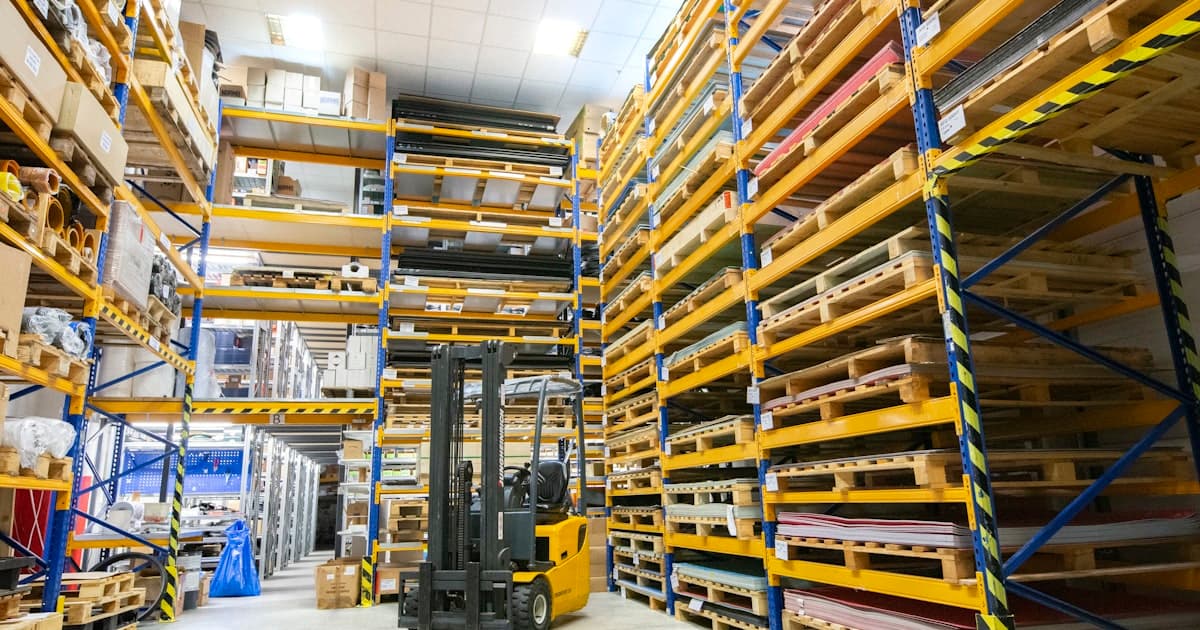
AI in logistics: where the money is for a mid-sized transport company
One in four kilometres empty, 15,200 vacancies and four data sources nobody joined up. Where AI actually pays back in logistics, in order of feasibility.
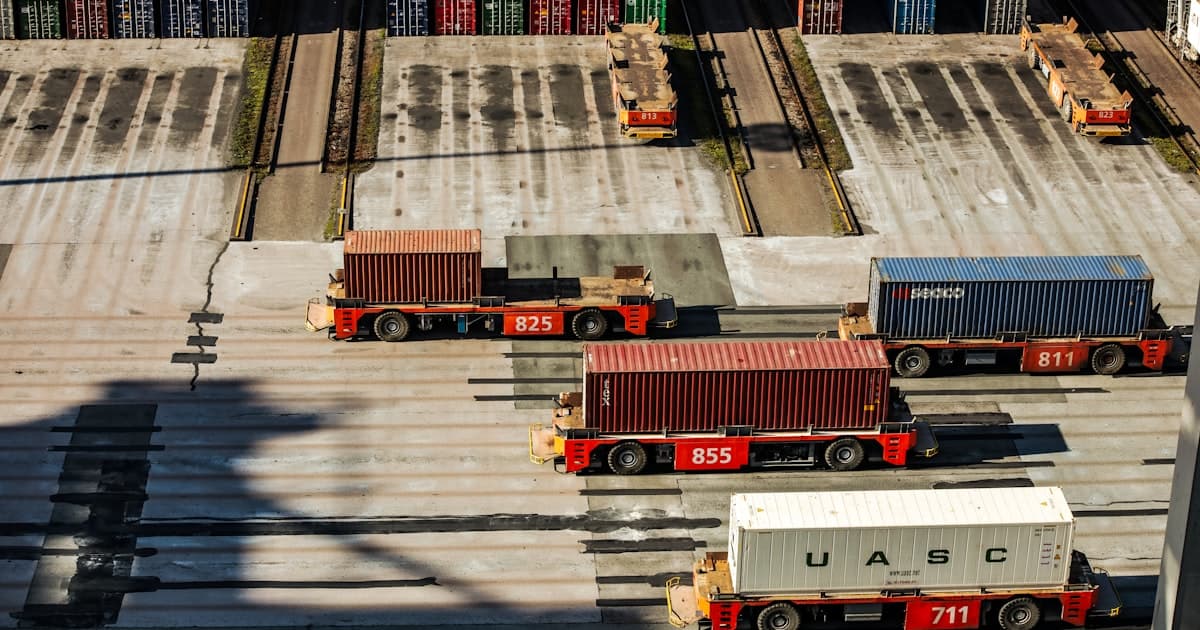
Of every four kilometres a Dutch truck drove in 2025, roughly one was empty. Statistics Netherlands puts it at 26 per cent of all vehicle kilometres run without cargo, and for purely domestic transport it is 30 per cent. That is not sloppy planning. It is the sum of trips that simply end somewhere with no return load waiting.
That is where the conversation about AI in logistics starts, not with self-driving trucks. For a transport or distribution company of fifty to three hundred and fifty people the question is not whether the technology is impressive. The question is which of your existing numbers you could use better than you do now, and what that returns within a quarter.
Who this piece is for
The sector is enormous and small at the same time. In the third quarter of 2026, Statistics Netherlands counts nearly 70,000 companies in transport and storage. More than 54,000 of those are one-person businesses, usually a self-employed driver. Companies with fifty or more people number just over nine hundred.
Those nine hundred are the reason this piece exists. They are big enough to run their own planning, their own TMS and their own administration, and small enough that they cannot fund a data department. For them almost all AI content on the market is unusable, because it was written for outfits with hundreds of trucks and a team of analysts.
 A truck on a Dutch motorway. Just over nine hundred transport companies have fifty or more employees.
Where the gains are, in order of feasibility
Return loads and trip combination. The most cited and the hardest. A model predicting where cargo will free up three days from now is only usable if you have enough volume yourself or you are plugged into an exchange with real data. For a company with forty trucks it rarely delivers a revolution, but it does deliver a few percentage points less empty running. Do not count on going from 26 to 10 per cent.
The document flow. The dullest application and by far the fastest. Waybills, customs papers, packing slips and purchase invoices that are retyped by hand today can largely be read and checked automatically. The work does not disappear, it shifts from retyping to reviewing. In most companies there is more immediate time saved here than in planning, and nobody talks about it because it does not sound exciting.
Volume forecasting. With two or three years of order history you can predict with reasonable confidence how many trips or orders arrive per week, per customer and per region. That helps with staffing, with hiring charters and with the conversation you have with a customer about peaks. The data for it is already sitting in your order system.
Maintenance and damage. Predictive maintenance works, but it needs sensor data across several years and several vehicles. For a mid-sized fleet this is usually a year-two thing, not a quarter-one thing.
The four side by side, so you can compare before you choose.
| Application | Data you already have | Realistic lead time | Who checks the output |
|---|---|---|---|
| Document flow | Waybills, invoices, packing slips | 6 to 10 weeks | Administration, daily |
| Volume forecasting | 2 to 3 years of order history | 8 to 12 weeks | Planning, weekly |
| Return loads and trip combination | Full trip history from the TMS | 3 to 6 months | Planning, per trip |
| Predictive maintenance | Sensor data across several years | Year two | The workshop |
The right-hand column matters more than it looks. An application whose output nobody in your company can judge is an application you have to take on faith. So start at the top of that list and not at the bottom, even though the bottom is more interesting.
What you already have
The biggest misconception about AI in this sector is that it is about new systems. It almost never is. An average transport company has been sitting on four sources for years that are rarely joined up.
Your TMS holds every trip you ever ran, with departure, arrival, weight and customer. The on-board computers hold kilometres, driving times, fuel consumption and idle time. Your financial administration holds what each trip cost and earned. And the planning team's mailbox holds the part that exists nowhere else: the arrangements, the exceptions, and the customer who always loads late.
The first three are worth a lot the moment they sit together. The fourth is the problem, and no tool solves it. More on that below.
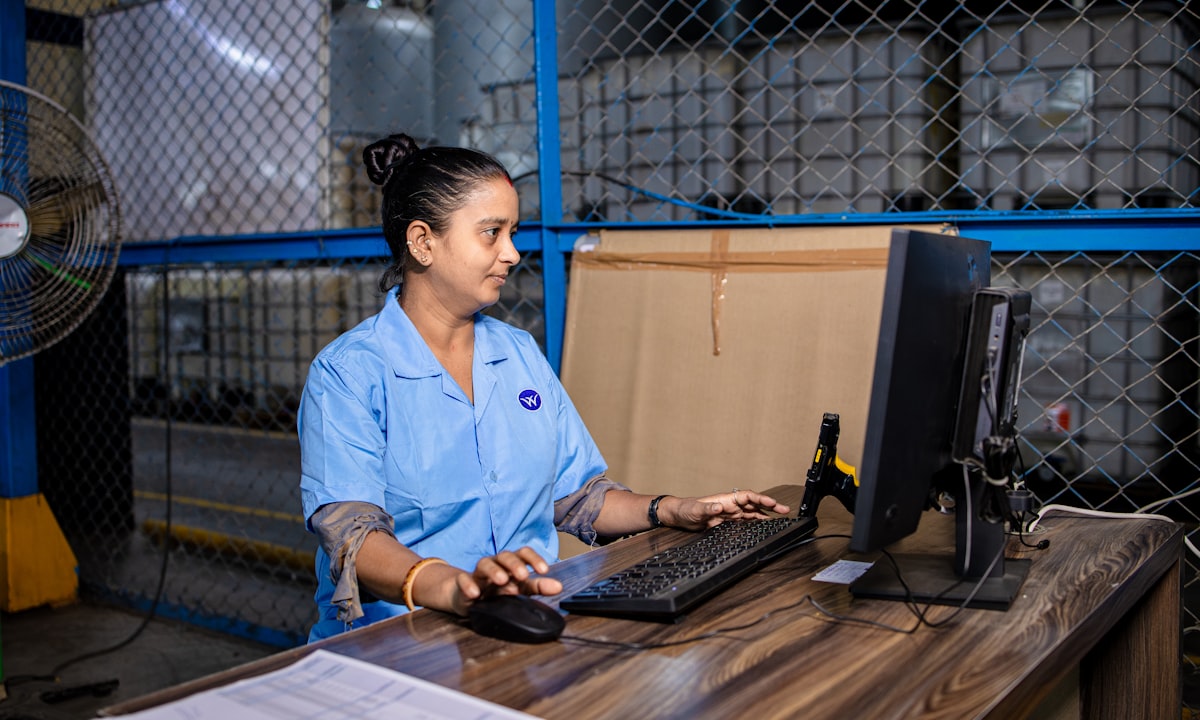 Planning at a screen on the warehouse floor. The part that matters most is not in any system.
The sum you can do yourself
Take your own fleet and fill in your own numbers. Say forty tractor units averaging 100,000 kilometres a year, so four million kilometres. At 26 per cent empty that is over a million empty kilometres a year.
Now the honest estimate. Do not assume you will halve it. Assume two to three percentage points, and that is already ambitious. Three percentage points on four million kilometres is 120,000 kilometres less. At consumption around thirty litres per hundred kilometres that saves roughly 36,000 litres of diesel a year. Put in your own price per litre and you have the ceiling of your business case on fuel alone, before hours and maintenance.
That is a real amount, and it is not an amount you set up a department for. Which is exactly why it goes untouched in companies like this: too small for a project, too large to ignore.
Staff is the real bottleneck, and AI does not solve it
In the second quarter of 2026 there were 15,200 open vacancies in transport and storage according to Statistics Netherlands, 7,800 of them in land transport. That number is higher than before the pandemic.
Be honest about this: no model drives a truck. Where it does help is at the other end of the company. If your planning team loses three hours a day chasing documents and retyping orders, that is capacity you get back without hiring anyone. The same holds for administration and customer service.
That is also the honest answer to whether AI costs jobs in logistics. In the office, work shifts. Behind the wheel, little changes for now.
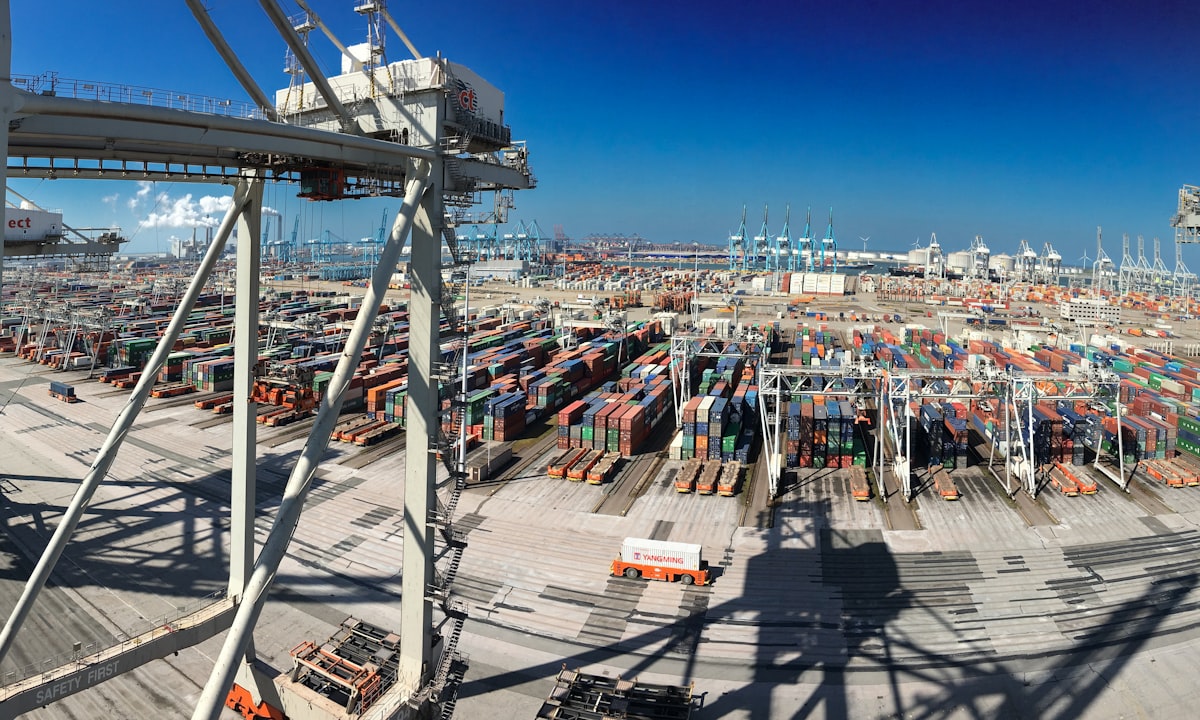 A container yard. In the office work shifts; behind the wheel little changes for now.
Two things that pinch legally in this sector
The AI Act is risk-based and has no company-size threshold, which we covered separately. Two applications that come up regularly in logistics deserve a warning of their own here.
In-cab cameras that infer fatigue or emotion. Systems that only watch whether someone closes their eyes or looks away generally stay clear; systems that infer an employee's emotions fall under the Article 5 prohibition and have not been allowed in the workplace since February 2025. The distinction is narrow and your vendor is not the one carrying the risk. Ask of every in-cab system exactly what it infers, and get the answer in writing.
AI in recruitment and selection. Recruiting drivers is the biggest bottleneck in this sector, so automated pre-selection is tempting. That sits in Annex III and is therefore high risk. The main obligations apply from 2 December 2027, so there is time, but not unlimited time.
For both, you have to be able to show who uses which system and what those people know about it. That is the core of AI literacy, and it belongs in your AI policy.
Four questions to ask every vendor
There is not a transport company in the Netherlands right now that is not being called by someone with an AI solution. The following four questions filter out most of them, and they cost you ten minutes.
What data was this trained on, and is mine in it? A model trained on German long-haul does not predict your urban distribution. Ask about origin and about period, and check whether a full season is in there.
What happens to my data? Does your trip history feed the vendor's model, and with it possibly your competitor? Get it in writing that your data is only used for your model. This is not a theoretical point; it is the most common bad clause in these contracts.
What can I change myself without you? If the answer amounts to a ticket and a two-week wait, you are buying a subscription, not a capability. Ask concretely who on your side can touch the settings and what that takes.
Who is the provider in the sense of the AI Act? Put the system out under your own name, or change its intended purpose, and you become the provider yourself, with the obligations moving to you. Have the vendor state in writing which role they take.
Who does this work in a company of a hundred people
This is the question that comes after the business case, and the answer is rarely a new job title.
What you need is someone who knows your own processes and can judge a model's output. In most transport companies that is the planner with the most years, or someone in administration who happens to be good with numbers. Freeing that person up one day a week and training them deliberately returns more than hiring a data scientist who does not know your floor.
That is not kindness, it is arithmetic. The knowledge that makes the difference in planning is not for sale and not on Google, because it sits inside your own company. An external party can build the model; whether the output is right can only be answered by someone who knows that one loading bay in Venlo always overruns by an hour.
External help is fine for the build and for the first few months. It goes wrong the moment that party leaves and nobody is left who understands why the model does what it does. Then you bought a system instead of building a capability, and you only notice the difference when something breaks.
Where it goes wrong in practice
The pilot runs on the wrong data. A model trained on six months of trip history mostly learns your summer. Season, public holidays and that one large customer who left halfway are not in it.
The planner is not at the table. This is the big one. In every transport company the real planning partly lives in the heads of two or three people: which driver works at which customer, which loading bay always overruns, which cargo you do not stack. Build around them and you get a system that is correct on paper and ignored in practice. Making that knowledge explicit is the actual work, and it is precisely the part a vendor cannot do for you.
You buy a system instead of capability. A tool you cannot steer yourself is a subscription, not a capability. If the party that built it walks away and nobody in your company understands why the model does what it does, you are stuck.
What a first quarter looks like
Start by looking, not by building. Put the four sources side by side and see where the gaps are; in most companies that is a confronting week. Then pick one application whose output you can check yourself, and that is nearly always the document flow rather than the planning. Run it alongside the existing process rather than instead of it, and measure the difference in hours.
Only once that works, and your own people understand why it works, do you move to planning. The other way round is the order in which most projects run aground.
About this page
The figures on empty kilometres, vacancies and company counts come straight from the open data of Statistics Netherlands and are listed below with their table numbers, so you can check them yourself. The worked examples are a method, not a promise; put in your own fleet and your own costs. This is the state of play on 7 August 2026.
Frequently asked questions
Sources
- CBS 83077NED: Wegvervoer, kerncijfers, voertuigkilometers totaal en beladen per jaar— cbs.nl ↗
- CBS 80472NED: Vacatures naar economische activiteit, vervoer en opslag per kwartaal— cbs.nl ↗
- CBS 81589NED: Bedrijven naar bedrijfstak en grootteklasse, vervoer en opslag— cbs.nl ↗
- AI Act artikel 5: verboden praktijken, waaronder emotieherkenning op de werkvloer— artificialintelligenceact.eu ↗
- AI Act bijlage III: de hoog-risicocategorieen, waaronder werving en selectie— artificialintelligenceact.eu ↗
- Verordening (EU) 2026/1744, de Digital Omnibus, met de verschoven datums— eur-lex.europa.eu ↗
Tell us what you need.
We respond within 24 hours, from a real human.
Get in touch