The priority matrix: choosing among ten AI opportunities
The boring, high-feasibility opportunity usually loses the conversation to the ambitious one. It should not. How to rank AI ideas honestly.

Ten AI opportunities on a list, and none of them is a wrong choice. That is exactly the problem. Every opportunity sounds worthwhile on its own, and without a way to weigh them against each other you end up picking whichever one was presented loudest, not the one that pays off most.
The priority matrix we use in every AI Readiness Scan is not a secret formula. It is two questions applied to every opportunity, which together produce a ranking you can stand behind yourself.
The two axes
Impact: what does it deliver if it works? Not in vague terms like "more efficient", but in hours, euro, or another number you can check. See also our AI ROI calculation model for how to work that figure out yourself.
Feasibility: what stands in the way of building it? Data availability, technical complexity, and perhaps most important: how much resistance exists within the company against this specific change.
 A marker beside sticky notes. Two axes turn a list into a ranking.
The four quadrants
Plot every opportunity on a grid of these two axes, and four groups emerge.
| Low feasibility | High feasibility | |
|---|---|---|
| High impact | Big but hard: keep for later, do not discard | Start here |
| Low impact | Skip it | Only if it takes half a day |
The top-right quadrant, high impact and high feasibility, is rarely empty and almost always overlooked because it sounds less impressive than the top-left quadrant. A document check saving three hours a day that can be built on existing data loses the conversation to an ambitious forecasting model that might save ten hours a week if it first solves all the things it does not solve yet.
Why most companies pick top-left instead of top-right
The top-left quadrant is more attractive to talk about. It sounds ambitious, it fits the story a board wants to tell its supervisory board, and it feels like progress. The top-right quadrant sounds boring: a document check, a quote check, something nobody would present at a conference.
That is exactly why we start every scan with a question about frustrations instead of ambitions, as we described in why an AI scan is not an IT project. Frustrations almost always lead to the top-right quadrant. Ambitions almost always lead to top-left.
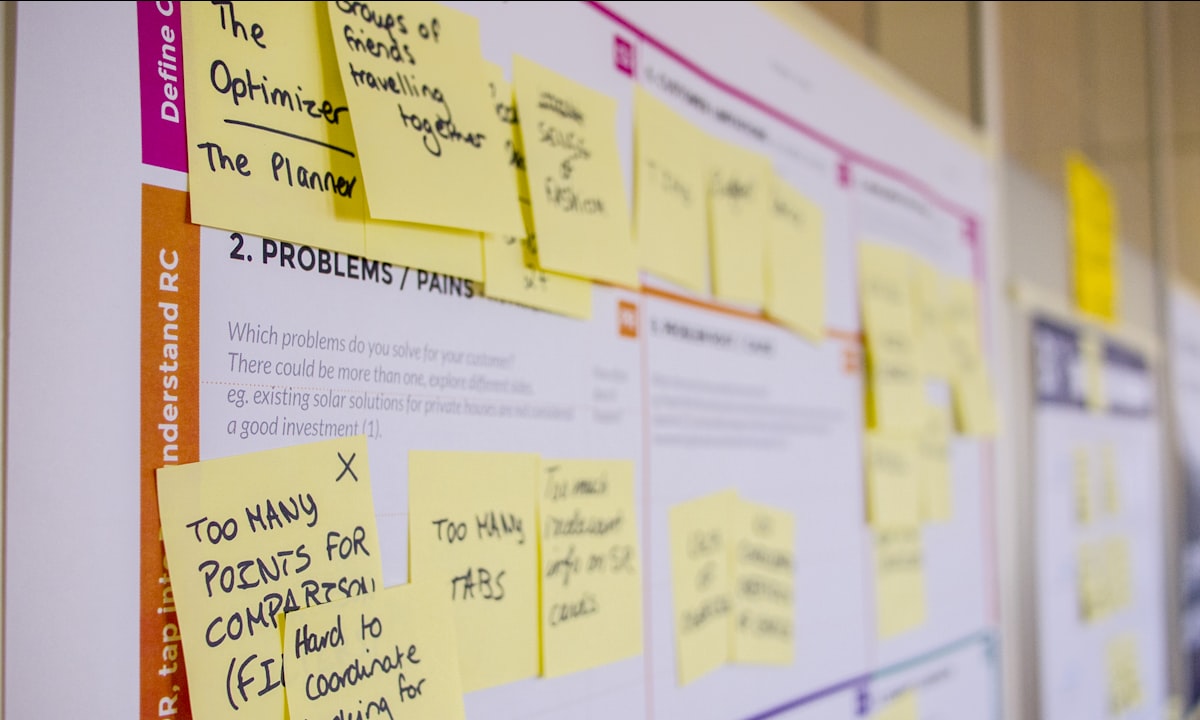 Notes on a board. Plot opportunities with the people who do the work, not just management.
How to honestly assess feasibility
Feasibility is the axis where most companies fool themselves, usually towards optimism. Three questions to make it more honest.
Does the data already exist, or does it need cleaning up first? An opportunity that looks feasible on paper but needs three months of data cleanup is less feasible in practice than it appears.
Who in the company will resist this, and why? Not all resistance is unwarranted. A planner who is rightly cautious, as we described in AI in operations planning, makes an opportunity less feasible, not because the technology would not work, but because adoption will stall.
Is there someone who can check the outcome? An opportunity nobody can judge the correctness of may be technically feasible and organisationally is not.
A filled-in example with five opportunities
Take a fictional company with five opportunities on the list: a customer service chatbot, invoice document checking, a stock forecasting model, automated quotes, and an AI assistant for management.
Document checking scores high feasibility, since the data already sits in the invoice system and the outcome is directly checkable, and moderate impact: a few hours a week. The chatbot scores low feasibility, since customer questions are highly varied and the first version will regularly get it wrong, against uncertain impact. Automated quotes score high feasibility and high impact, since the data is there, the outcome is checkable, and it directly saves hours per quote.
The ranking that comes out of this is not the ranking the company had going in. The chatbot was at the top because it sounded most impressive. After filling in the matrix, automated quotes moves to first place, and that is exactly the point of the exercise.
What the matrix does not solve
The matrix does not replace a conversation with the people doing the work, it structures that conversation. Plotting two numbers on a grid without talking to the planner or administrator who has to estimate impact and feasibility produces a false precision just as unreliable as a guess.
What to do with the matrix
Plot your ten opportunities on the grid with the people who do the work, not just management. A planner or administrator often estimates feasibility more realistically than a director who does not face the daily obstacles.
Then do not pick the highest-impact opportunity, pick the top-right one with the shortest distance to a working result. That first project produces the proof that makes the second, more ambitious one easier to sell inside the company.
About this page
This matrix is our own method, used in every AI Readiness Scan. It is not a scientific model but a practical tool for making explicit the choices that otherwise get made on instinct. This is the state of play on 31 August 2026.
Frequently asked questions
Tell us what you need.
We respond within 24 hours, from a real human.
Get in touch