Getting more out of the people you already have
The goal is not to replace anyone. It is to take repetitive work off people's plates, in a labour market where you would not find the people you are missing anyway.

In the first quarter of 2026, for every hundred unemployed people there were ninety-one open vacancies. That is less tight than the peak of a few years back, and it is still a labour market where you do not simply hire someone. Against that backdrop, the fear blocking every AI conversation on the shop floor, "is this going to cost me my job", is not only human. For most companies in our target audience, it is also factually wrong.
The point is not to replace anyone. It is to get more out of the people you already have, by taking the repetitive work off their plate. That is not a marketing line, it is the only approach that works in a labour market where you would not find the people you are missing anyway.
Why replacement should not be the goal even without the labour market
Setting the labour market aside, there is a practical reason "AI replaces people" is rarely the right ambition for a company of fifty to three hundred and fifty people: the work AI can genuinely take over is rarely all of what a job consists of.
An administrator does not only check invoices. That person also answers colleagues' questions, spots exceptions, and knows the customer behind the invoice number. AI can take over the checking. The rest of the role stays, and often becomes more important as the repetitive part disappears.
 Leaning back at a desk. The repetitive part disappears, the judgement stays.
The fear blocking every conversation, and why it feels real
Nobody needs to convince you this fear exists. You recognise it in the silence after the question "are we going to use AI", and in the colleague who suddenly has more questions about staffing than about the technology.
The fear feels real because most coverage of AI is about replacement. That is the story that gets clicks, not the story that actually plays out in most companies. In a labour market where companies already struggle to fill vacancies, the practice more often is that AI lets the same team handle more work, not that it does the same work with fewer people.
What happens in practice when you get this right
Three patterns we recognise at companies that handled this well.
The repetitive part disappears, the judgement stays. A planner who spent two hours a day manually entering orders keeps those two hours for the work where their experience actually counts: exceptions, customer contact, judging a tricky situation. See also our pieces on AI in operations planning and building capacity without your own AI team.
The people who already did the work become the new experts. In almost every project we have seen, it is not the most expensive external consultant who becomes the internal authority, but the employee who already knew the process and was first to learn the new system. That person gains standing instead of fear.
The vacancy you could not fill anyway is no longer needed. With 91 vacancies per hundred unemployed, hiring an extra person for a growing department is no certainty. A tool helping the existing team absorb the extra volume is in practice more often the alternative that actually works.
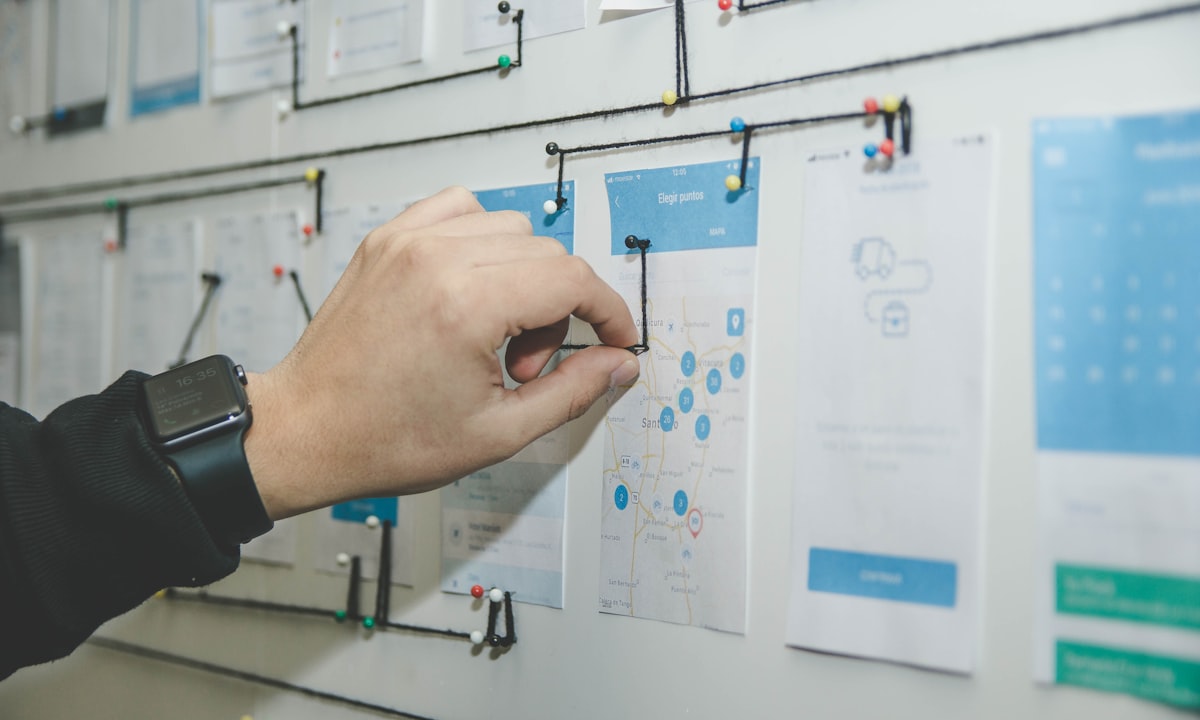 Working on a planning board. A tight labour market means the vacancy you could not fill is no longer needed.
How to have the conversation without feeding the fear
Start with the work, not the technology. Do not ask "what can AI do for us", ask "which part of your work would you most like to never do again". That question produces answers nobody resists, because everyone has such a part.
Show, do not promise. A colleague watching for half an hour while a repetitive task disappears believes it faster than a presentation full of promises. See also AI literacy: the same principle of showing instead of telling applies here.
Be honest about what does change. Something does change: the work looks different, and that asks something of people. Denying anything changes is just as unwise as pretending jobs disappear. The honest message is: the work shifts to the part people are better at than a model.
What a manager can concretely say
The right message is often shorter than directors think it needs to be. Something like: we are using this to take the worst part of your work away, not to take you away. We start small and we build it with the people doing the work now, not over their heads.
What you avoid is a big kick-off with an external party using the word "transformation". That word feeds exactly the fear you are trying to remove. A small experiment on one recognisable piece of work, with the people it affects at the table from day one, does more than any presentation.
What happens if you skip this conversation
Companies that adopt AI without having this conversation often see passive resistance instead of open pushback. A system that works technically gets used half-heartedly, with workarounds undermining the point. Nobody says out loud that they fear losing their job, but the behaviour shows the fear is there.
That costs more time than the conversation itself would have. Half an hour per team, upfront, is cheaper than months of half-hearted use afterwards.
What the figures show about where AI is actually used
At companies with 50 to 250 people, AI is used most often in administrative processes, followed by marketing and sales. Those are exactly the areas where repetitive work eats up the most time, and where companies have long struggled to fill vacancies. That is no coincidence: companies deploy AI where the need is greatest, not where the threat is greatest.
What to do this month
Have the conversation with three people separately, not in a team meeting where nobody wants to speak first. Ask about the part of their work they would most like to be rid of. Pick one small, recognisable piece of that work and show what happens when it disappears, before talking about the rest of the company.
About this page
The figure of 91 vacancies per hundred unemployed comes from Statistics Netherlands reporting on labour market tension in the first quarter of 2026. The figures on where AI is used come from the Statistics Netherlands ICT survey over 2025. This is the state of play on 20 August 2026.
Frequently asked questions
Sources
Tell us what you need.
We respond within 24 hours, from a real human.
Get in touch