What can AI actually do for my company?
The honest answer starts with your processes, not with the technology. Five concrete first applications from five sectors, and the three tests that separate them from a good demo.
The honest opening: nobody can answer this question without knowing your processes. What is possible is to show what a good first application looks like in companies resembling yours, and to give you the test for holding your own candidates to the same bar.
So not a list of possibilities. Five concrete examples from five sectors, followed by the three criteria they all meet.
The sectors are logistics, wholesale, operations planning, offshore and construction. Not because AI works differently there, but because these are companies where many people do a lot of manual work on processes that repeat every day, and where the labour market is tight enough that growing by hiring is no longer a realistic route. If you do not recognise your company among them, the examples still apply: the shape of a good first application is the same in every sector.
Why most examples are worthless
Search for it and you get applications that are impressive and have nothing to do with your company. Chatbots for customer service, content generation for marketing, predictive maintenance for a factory with a thousand sensors.
That is no accident. Those examples come from parties selling that product, and they describe where AI is most visible rather than where it delivers most.
Statistics Netherlands measures the difference well. Of Dutch companies using AI, 35 percent apply it to marketing or sales and 32 percent to business administration. For logistics it is 4 percent. The money goes where the attention is, not where the hours are.
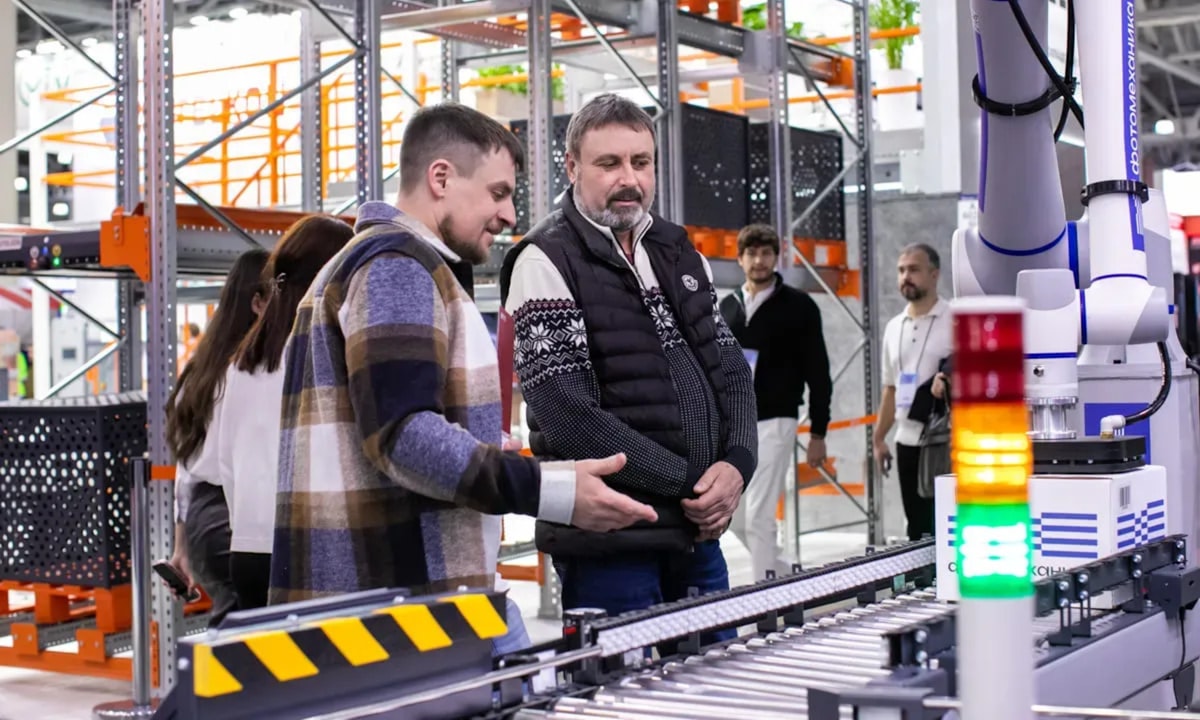 Watching an automated line. Planning work is judgement under time pressure, which is exactly where a suggestion helps.
Five first applications that do work
Logistics: the exceptions in the planning
The work is not in the runs that go smoothly. It is in the fifteen percent where something is up: a customer who cannot receive, a driver who calls in sick, a load that does not fit as planned. A planner spends most of the day on that, and it is precisely the work that is not in the TMS.
The application is not self-driving planning. It is a system that, on every disruption, proposes three possible replans within seconds, with the consequences attached, so the planner chooses rather than works it out. The decision stays with the planner. The search time disappears.
Why this works: it happens dozens of times a day, the data is already in your TMS, and a mistake is immediately visible and recoverable.
Wholesale: quotes and product questions
A wholesaler with tens of thousands of items fields questions all day that amount to: do you have something like this, and what does it cost. The answer sits spread across a product file, customer-specific pricing, stock positions and the salesperson's experience.
Assembling that answer takes minutes each time and happens hundreds of times a week. That is the arithmetic: not a spectacular application, but hundreds of hours a year.
The trap here: this is exactly the kind of process where a semantic layer is needed first. If an item number means something different in the ERP than in the webshop, the system confidently returns the wrong product. That is worse than no system, because the salesperson trusts it and the customer gets the wrong delivery.
Operations planning: the weekly schedule nobody can explain
In most planning environments there is one person who makes the schedule and who, asked why it looks like that, answers with experience. That is not a criticism, it is a compliment, and it is simultaneously an enormous risk when that person goes on holiday.
The application here is not replacement but capture. A system that places that person's schedules alongside the outcomes and surfaces the rules they apply implicitly. A second person can then produce a draft that the first only has to check.
What this delivers: continuity is the real return, not the time saved. A company dependent on one planner has a problem nobody puts in the budget.
Offshore: work orders and reporting
Offshore and industrial services run on documentation. Work orders, inspection reports, certifications, shift handover reports. Most of it is written or dictated by hand and then retyped into a system by someone.
That retyping is work with no added value that does consume hours and introduces errors. An application converting spoken or written field notes into a structured work order, with the usual fields filled and the rest flagged for checking, removes exactly that step.
Note: this often touches safety documentation, and then the question of who approves the output is not a formality. See human on the loop.
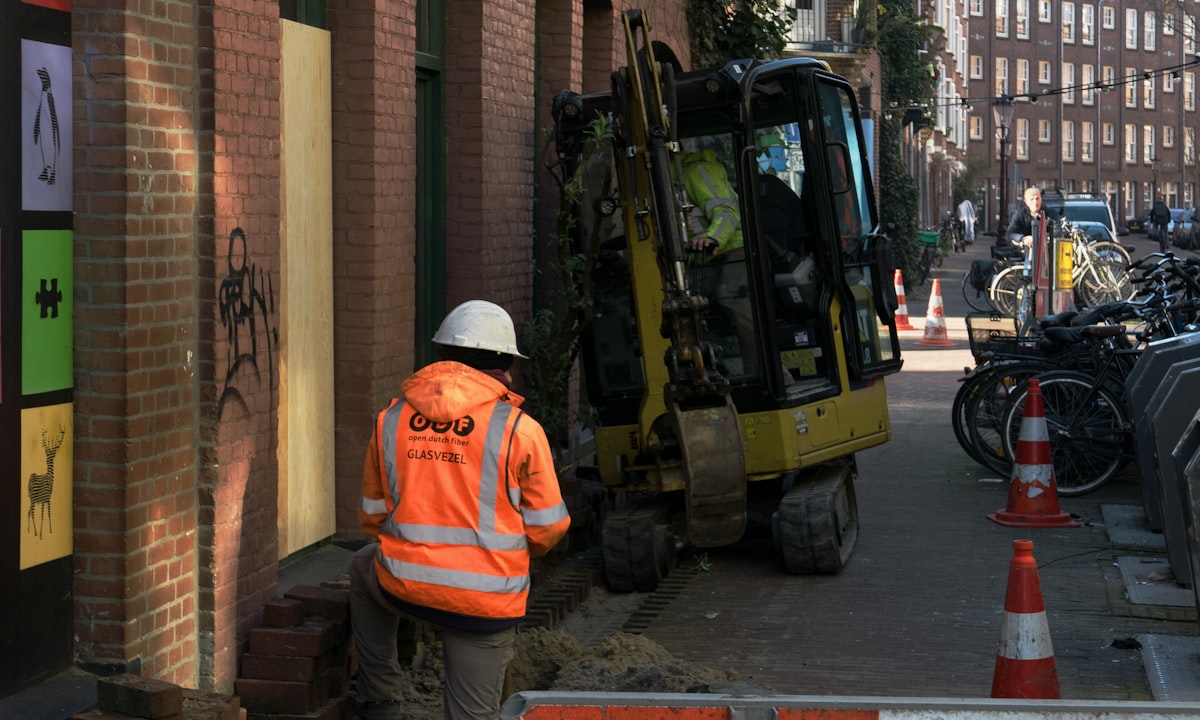 A construction worker beside a truck in Amsterdam. In construction, most of the recoverable time sits before the first shovel goes in the ground.
Construction: estimating and tendering
In construction, most of the recoverable time sits before the first shovel goes in the ground. An estimator reads specifications, extracts line items, requests prices from suppliers, and turns that into a quote. For every tender, largely the same way.
An application that reads a specification and produces a draft estimate based on your own historical prices removes the retyping and leaves the judgement. The estimator looks at the deviations rather than at everything.
Why this pays: you already have your own history, and that is the data this application needs. The number of tenders you win per hundred hours of estimating is also a figure you already track, so the measurement is easy.
The three tests
Each of the five examples meets the same three criteria. Hold your own candidates against them.
| Test | The question | Why |
|---|---|---|
| Volume | Does this cost more than five hundred hours a year? | Below that it almost never pays |
| Data | Does the information already exist in a system of yours? | Otherwise the project starts with data work instead of results |
| Recoverability | Is a mistake visible and fixable within a day? | Irreversible decisions do not belong in a first application |
The third is skipped most often. A first application should run somewhere a mistake is awkward rather than damaging. That is not caution, it is how you teach an organisation to trust something new.
What the five have in common
Put them side by side and something stands out. In none of the five does the system take over the decision.
The planner still chooses. The salesperson checks the suggestion. The estimator looks at the deviations. What disappears is the search time, the retyping and the working out, and that is precisely where the hours go without any judgement being involved.
That is not modesty and not a stepping stone to something bigger. It is the reason they work. An application that takes over the judgement asks for trust that does not exist yet, and in month three it meets an exception after which nobody uses it again. An application that does the groundwork and leaves the judgement is missed the moment it goes down.
It also explains why the most cited applications are rarely the most profitable. A chatbot handling customers does take over a judgement. A system presenting the planner with three options does not.
From five examples to your first application
The step most companies skip is writing it down. Not because it is hard, but because it is boring and everyone assumes it is already known.
Take a sheet of paper. Write down three processes you suspect consume a lot of time. Against each, note four things: roughly how many hours a year it costs, who knows it best, which system holds the data, and what happens when it goes wrong.
Three things nearly always come out of that. First, that you do not know the hours, which is a finding in itself: if nobody knows what a process costs, you cannot establish whether it improved. Second, that one name appears against all three rows, and that is simultaneously your biggest risk and your most important ally. Third, that the process with the most hours is rarely the process you had in mind when you started thinking about AI.
That sheet is more useful than any vendor presentation, because it is the only document with your company in it rather than an average company.
The order within a year
A realistic first year looks roughly like this, and it is strikingly calm.
The first quarter is about choosing and measuring. You establish which process it will be, you record what it costs today, and you appoint someone allowed to decide about it. Nothing is built this quarter, and that is not a delay but the reason the rest succeeds.
The second quarter is the build, with your own people working rather than sitting in. The third quarter is the real work: the exceptions surfacing once people use it daily. Expect more time to go into that than into the build itself.
Only in the fourth quarter does the question of a second application arise. Ask it in quarter one and you build wide rather than deep, and end the year with four half-finished things.
What AI will not do for you
Equally clearly, because this prevents six months of disappointment.
AI will not make a decision you cannot yet explain. If nobody can say why one order gets priority, no model will solve that for you; it will only make the arbitrariness faster and more consistent.
AI also does not repair a process that does not work. A quoting process taking three weeks because four signatures are required does not get faster with a model. That is an organisational question with an organisational answer.
And AI does not replace the people who know the exceptions. That knowledge is exactly what the first application leans on.
A fourth, mentioned less often: AI does not improve bad data. It only makes the consequences faster and more convincingly presented. A system confidently returning the wrong item number does more damage than an employee who hesitates and goes to check.
The arithmetic
An example makes it concrete. Take a process of 1,200 hours of manual work a year. Remove a substantial share of it and the saving lands around EUR 68,000 a year, with payback under three months.
That is a worked example, not a promise. The value is in the shape: hours times loaded rate times the share you genuinely remove. The same sum also shows where it does not add up, and that conclusion is just as useful.
The goal, moreover, is rarely to replace people. It is to do more with the people you have, in a labour market where the people you are looking for do not exist. For much of our audience that is the real argument: not saving, but growing without the staffing shortage acting as the brake.
Where to begin
Make the list first. Three processes you suspect run above five hundred hours a year. Note who knows them, which system holds the data, and whether a mistake is visible within a day.
If you cannot decide between the three, pick not the largest but the one with the shortest route to a checkable result. The first application does not have to be the most valuable one, it mainly has to get finished.
One fully completed row means you have your first candidate. The AI Photo helps you make that list in ten minutes and costs nothing. If you then want them ranked and costed on your own figures, that is precisely what the AI Readiness Scan delivers in ten working days.
Frequently asked questions
Sources
- CBS: bedrijven gebruiken AI het vaakst voor marketing of verkoop, met percentages per bedrijfsfunctie— cbs.nl ↗
- evofenedex: ondernemers in handel en logistiek lopen achter met AI-adoptie— evofenedex.nl ↗
- CBS: gebruik van kunstmatige intelligentie door bedrijven neemt toe— cbs.nl ↗
- Radical AI: de AI Readiness Scan, kansen gerangschikt en doorgerekend— radicalai.nl ↗
- Radical AI: de AI-Foto, gratis zelfscan van twaalf vragen— radicalai.nl ↗
Tell us what you need.
We respond within 24 hours, from a real human.
Get in touch